Part 7 of 10 — Delay & Disruption Quantum Guide
Suppose a project finishes ten weeks late, and ten weeks of compensable delay is established. Which ten weeks of cost should be used to price it? The answer can change the claim value by a factor of two or more.
The two competing positions
- Overrun period: the extra cost "bites" only once the contractor remains on site beyond the original (or extended) completion date, so price the delay using costs in that tail period.
- Period of impact: price the delay using the resources that were actually affected when the delay occurred.
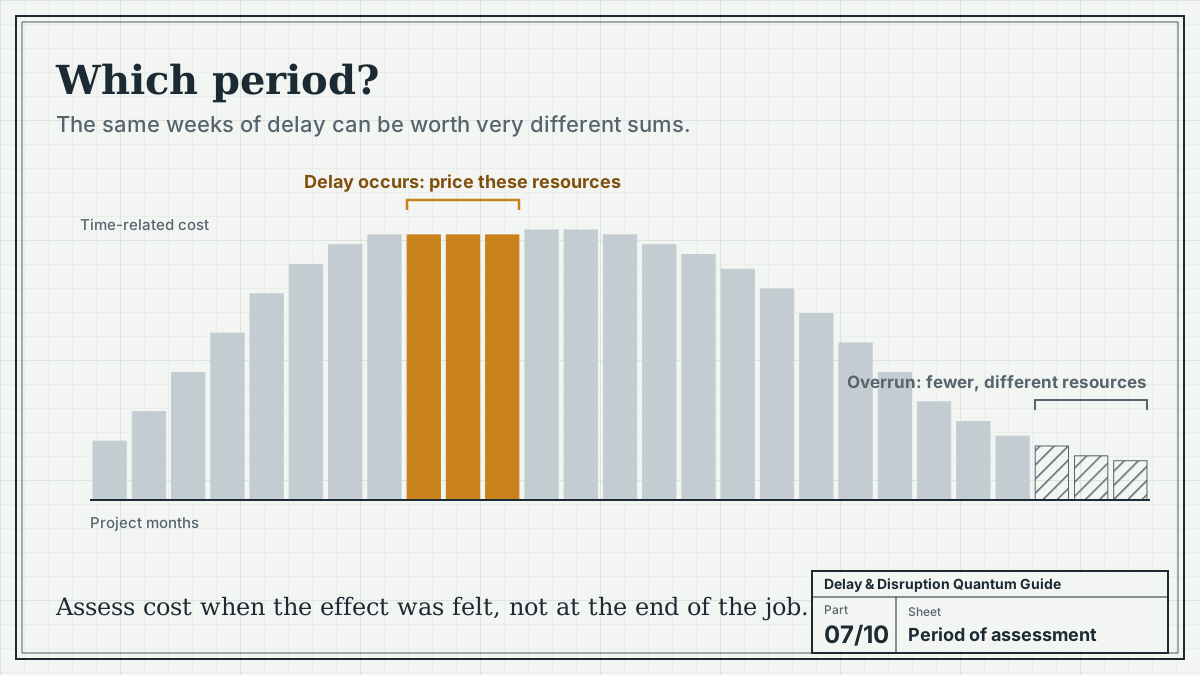
The SCL Protocol (2nd edition) favours the second: once compensation for prolongation is established, it should be evaluated by reference to the period when the effect of the employer risk event was felt, not by reference to the extended period at the end of the contract.
The causation principle
The paying party will often argue that extra cost should be taken from the period after the extended completion date — which, because site resources are usually lower at the end of a project, produces a much smaller figure. The better view, and the one reflected in the SCL Protocol, is that:
- when extra costs are incurred because of delay is a question of causation, and therefore a question of fact;
- it is wrong simply to bolt the delay onto the end of the contract and use whatever costs were incurred then; and
- extra costs must be assessed by reference to the actual impact on the contractor's progress.
Neutral delays within an extended period raise a related point. If employer delay pushes the contractor into a later period that contains neutral non-working days (weather, public holidays, for example), the time-related cost of those days may be caused by the original employer delay. Where individual neutral periods cannot be precisely identified, a reasoned percentage adjustment to daily costs may be a legitimate way to reflect this — but it must be put to the parties and properly explained.
There is also an important limit on what is being measured. A clause compensating "extra costs" caused by delay does not necessarily compensate lost income from being unable to take on other work. That distinction returns in Part 8.
Why the end of the project is usually the wrong proxy
On most real projects, the resources on site during the overrun period bear little resemblance to those delayed earlier. Consider an illustrative metro station:
- An employer-risk delay to diaphragm wall access occurs in month 8, when the site is staffed for heavy civils: a large engineering team, crawler cranes, piling plant, temporary works designers, traffic management.
- The project overruns in months 31–33, when the site is in systems integration and testing: a smaller team of commissioning engineers, and very little plant.
Pricing the month-8 delay with month-31 costs would understate the loss, and it would value the wrong resources altogether. The reverse can also happen: a delay during a quiet early phase, priced at peak-phase resource levels, would overstate it.
Not every case is the same
Whether the extra cost is "felt" during the delay or in the overrun depends on how the project's resources and spend profile actually behaved.
Simple, linear projects. If a single critical activity is delayed, resource levels are constant throughout, nothing is redeployed, and there is no escalation, then the contractor does not incur any extra cost until the overrun — the costs during the delay would have been spent anyway. Here, delay period and overrun produce the same answer.
But even in that simple case, the contractor may suffer cash-flow loss earlier: it keeps paying for resources monthly while certifying little or no progress, so it can be out of pocket long before the overrun begins.
Real projects. Resources join and leave at different times, spend follows an S-curve, and delays strike in different phases. Here, a resource-specific analysis is needed. For each resource the question is: but for the delay, when would it have left, and when did it actually leave? Some resources will be retained longer; some will simply arrive later (same cost, shifted in time); some will be redeployed to mitigate.
Two practical approaches
Resource-by-resource "but for" analysis. Suited to shorter projects with fewer resources. Each time-related resource is compared — planned presence versus actual presence — and only the genuinely additional time is priced, at the time it was incurred.
Delay rate per day. Suited to longer, larger projects where most time-related resources are present throughout the period of each delay and are extended by it. A daily rate is derived from the time-related resources on site during each delay window (not the overrun) and applied to the compensable days for that window. Most mid-sized and large projects fall into this category.
A secondary check is always required
Even when the right period is chosen, not all costs in it are automatically recoverable. The expert must still confirm that each cost is:
- genuinely time-related;
- attributable to compensable critical delay;
- reasonable;
- actually incurred (or a liability has arisen, depending on contract wording); and
- correctly dated — accounting systems often book costs when invoices are paid, not when resources were on site.
Practical takeaways for counsel
- Check which period the opposing expert has used and whether it matches when the delay actually occurred.
- Ask for the resource histogram or spend profile across the project; it will show quickly whether the chosen period over- or understates the claim.
- Do not let neutral delays within extended periods be ignored — they may carry cost consequences.
- Expect a tribunal to treat timing as a factual causation issue, not a formula.
Previous: Part 6 — When the Contract Sets the Price. Next: Part 8 — Overheads, Profit, Finance and Lost Production.
General information only, not legal advice.