Part 9 of 10 — Delay & Disruption Quantum Guide
Every quantum calculation rests on a causal chain: an event at the other party's risk caused this delay or disruption, which caused this cost. Two situations put that chain under particular strain — concurrent delay, and the global claim.
Part A: Concurrency and money
Time and money are treated differently
How concurrent delay is identified, and what follows from it, depends on the contract and the law of causation in the governing jurisdiction. But across many common law systems a broad pattern has emerged:
- For time, the contractor is often granted an extension for the employer-risk delay, notwithstanding a concurrent contractor-risk delay. This is the approach recorded in Henry Boot Construction (UK) Ltd v Malmaison Hotel (Manchester) Ltd (1999) and later approved in English cases; US authority reaches a similar result (concurrent delay is excusable but not compensable). The SCL Protocol is consistent with it.
- For money, the "but for" test is applied more strictly. A contractor generally cannot recover delay costs it would have suffered anyway because of its own concurrent delay (De Beers UK Ltd v Atos Origin IT Services UK Ltd [2010] EWHC 3276 (TCC)).
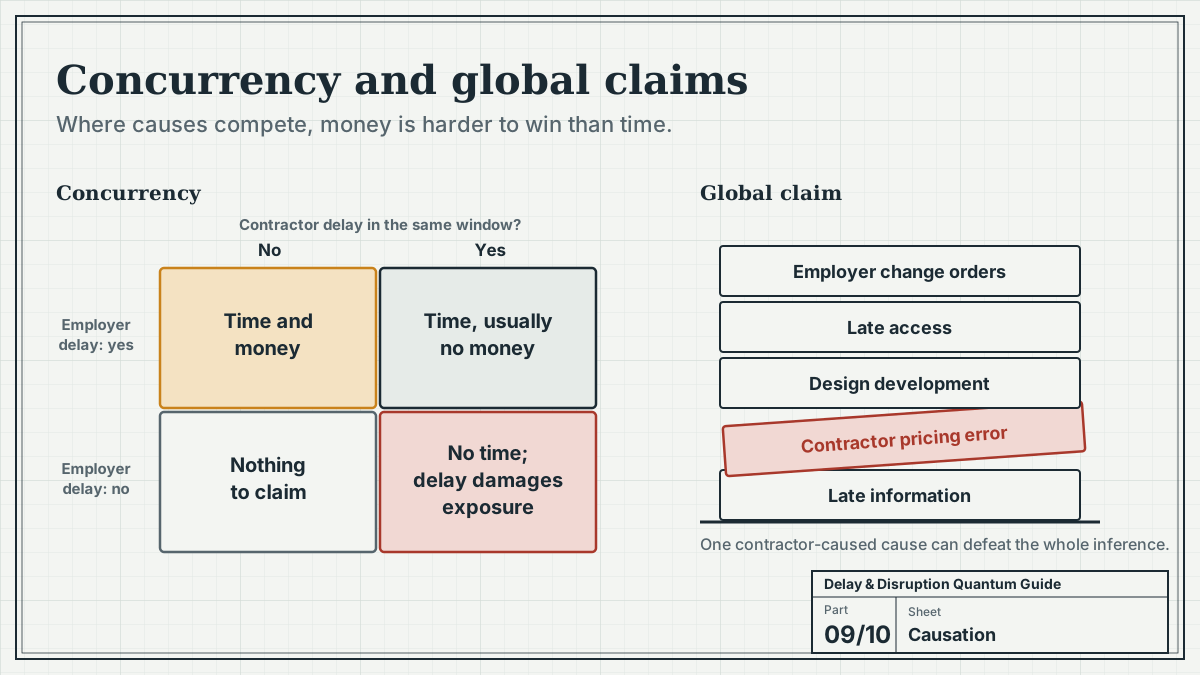
The practical result is frequently "time but no money" for the concurrent period.
Approaches to competing causes
Tribunals and commentators have identified several approaches to apportioning responsibility where causes compete. Which applies — if any — depends on the contract and governing law:
| Approach | In short |
|---|---|
| Malmaison | Time granted for the employer-risk event despite concurrent contractor delay |
| Dominant cause | The effective, dominant cause carries liability — supported in some Scottish and English decisions, rejected in others |
| Apportionment | Delay or loss split between causes by relative contribution (City Inn v Shepherd, Scotland); some standard forms provide for it expressly |
| Material contribution | Recovery in full if the defendant's breach materially contributed (a tort-derived approach) |
| "But for" | Recovery only for loss that would not have occurred but for the event |
| Burden of proof | Where the claimant's own breach contributed, it must show what part of the loss was not caused by it, or recover nominal damages |
| Devlin | Where two causes of roughly equal efficacy co-operate, the breach may be sufficient to carry the loss |
GCC note. UAE and other civil law systems have their own principles on causation and shared fault, and parties frequently amend FIDIC to deal with concurrency expressly. The treatment of concurrency in money claims must be confirmed against the contract and governing law. [Verification flag — legal review required]
What this means for quantum
The quantum expert does not decide concurrency — that is for the delay expert and, ultimately, the tribunal. But the quantum expert should:
- be able to price delay periods on alternative concurrency findings;
- identify which costs fall in concurrent windows; and
- show the effect on the claim of each scenario.
A quantum report that can only produce one number, on the claimant's case at its highest, is of limited help to a tribunal.
Part B: Global claims
What a global claim is
A global claim (sometimes called a total cost, total time or rolled-up claim) takes the difference between actual and planned cost and attributes it to the cumulative effect of events for which the other party is said to be responsible — without linking each event to its own consequences.
In effect, the claimant asks the tribunal to infer causation: there is no other explanation for the overrun, so the respondent must be liable for it.
Can it succeed?
Difficulty in calculating damages is not, by itself, a reason to refuse them. But the claimant must still show how the loss was caused.
The case law has tended to move from a relatively permissive view — that a global claim might be maintained where it was impossible or impractical to link events to effects — towards a firmer line. A total cost approach is generally tolerated only where it is genuinely impracticable to disentangle the loss and that situation is not of the claimant's own making. Even then, causation must still be proved, and a global claim is unlikely to succeed where other causally significant events exist for which the respondent is not responsible. In that situation, the claim is likely to fail entirely.
The fragility is structural. If the respondent can show that any material part of the overrun was caused by the claimant — a pricing error, poor productivity, its own subcontractor's default — the inference collapses.
Pre-conditions a global claim must meet
At a minimum, the claimant should be able to show:
- A reasonable tender. The planned cost baseline must itself have been achievable. A claim based on the difference between actual labour and an agreed labour quantity will fail if there is no evidence that the agreed quantity was sufficient to do the work in the first place.
- No contractor-caused overrun. Every material cause of extra cost must be at the respondent's risk.
- Genuine impracticability of separation, not caused by the claimant's own failure to keep records.
- Evidence of actual disruption, preferably at "micro" level — contemporaneous packages of evidence for specific events — supported where possible by "macro" analysis such as a measured mile comparison.
The more factual evidence there is of actual delay and disruption, the more likely the inference will be drawn.
The better course
The clear message is to avoid global claims wherever possible. Contractors should set up projects to support cause-and-effect analysis from day one: accurate records, regular programme updates, cost coding that captures why cost was incurred, not just that it was. A claim built event-by-event is more work, but it does not collapse when one cause is shown to be the claimant's own.
Practical takeaways for counsel
- Ask whether the claim is truly event-by-event, or a total cost claim presented in event-by-event clothing.
- On the respondent side, look for any contractor-caused contribution; it may defeat a global claim outright.
- Require the quantum expert to model concurrency scenarios rather than a single figure.
- Check the tender baseline before relying on any "planned versus actual" comparison.
Previous: Part 8 — Beyond the Site. Next: Part 10 — Proven, Estimated or Speculative.
General information only, not legal advice.