Part 1 of 10 — Delay & Disruption Quantum Guide
On site, "delay and disruption" is spoken as a single phrase. In a quantum report, treating it as one concept is one of the fastest ways to lose credibility with a tribunal.
Two different questions
The simplest way to hold the distinction is this:
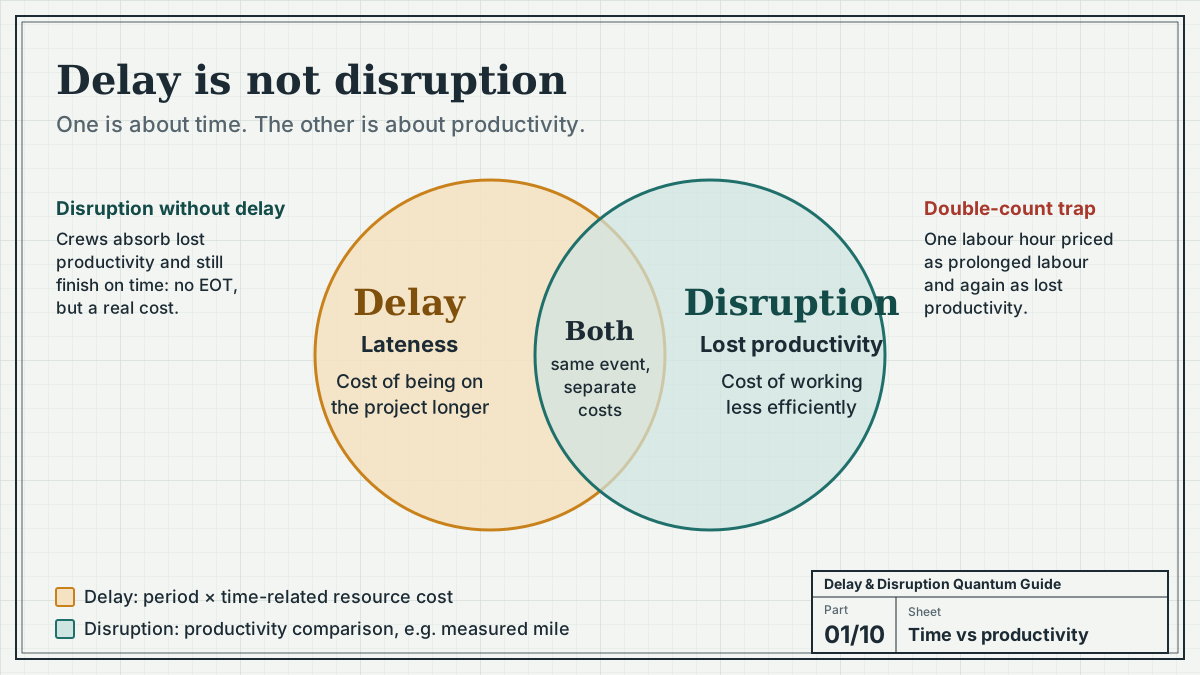
- Delay is about time. Something finished later than it should have. The financial consequence is the cost of being on site, or being engaged on the project, for longer.
- Disruption is about productivity. Work was carried out less efficiently than it reasonably should have been. The financial consequence is the extra effort — usually labour and plant hours — needed to produce the same output.
The Society of Construction Law Delay and Disruption Protocol (2nd edition, 2017) frames disruption as interference with a contractor's normal working methods that reduces efficiency, and it identifies both direct causes (piecemeal access, out-of-sequence working, design change) and secondary effects such as trade stacking, diluted supervision, fatigue from sustained overtime, repeated learning curves and falling morale.
United States authority draws the same line in plain terms: a delay claim is about the cost of not being able to work; a disruption claim is about the cost of working less efficiently than planned (Bell BCI Co v United States).
They interact — but they are not interchangeable
The two concepts are related in every direction:
- Delay can cause disruption (a late access date compresses later work and forces trades to overlap).
- Disruption can cause delay (persistent low productivity on a critical activity pushes out completion).
- Both can occur together from the same event.
- Disruption can occur with no delay at all. A contractor can absorb a productivity loss through extra resources and still finish on time. There is then no extension of time to claim, but there may be a real cost of the inefficiency.
That last point is where many claims go wrong. A contractor that finishes on time, having thrown resources at a disrupted package, sometimes assumes it has no claim because there is no delay. Conversely, a contractor that has been delayed sometimes assumes every additional labour hour is "delay cost". Neither assumption is safe.
Why the separation matters in practice
1. Entitlement differs. Many standard forms give an express route to recover time-related cost for critical delay, but are silent or narrower on disruption. If the contract offers no mechanism for disruption cost, the claim may have to be framed as damages for breach, with a different burden and a different legal analysis. Under FIDIC, for example, the Sub-Clause relied upon must actually entitle the Contractor to Cost (or Cost Plus Profit) for the event in question.
2. The forum may depend on it. In some jurisdictions, statutory adjudication is limited to disputes arising under the contract. A claim with no contractual footing may not be adjudicable at all. In the GCC, where dispute boards and arbitration are the more common routes, the equivalent risk is a tribunal finding that the claim was not properly notified or particularised under the clause relied upon.
3. Double counting. If delay and disruption are not separated, the same labour hour can easily appear twice: once as prolonged labour in a time-related claim, and again as lost productivity. Tribunals look for this, and a single instance can taint the credibility of the whole calculation.
4. Combined claims fail. Where a claimant rolls delay and disruption into one undifferentiated figure, it is asking the tribunal to do the separation for it. English courts have been confronted with exactly this problem (Van Oord UK Ltd v Allseas UK Ltd [2015] EWHC 3074 (TCC); RWE Npower plc v Alstom Power Ltd). The usual outcome is a significant discount, or failure of the unseparated element.
Courts treat them as separate heads of loss
Even though labour effort and programme duration are connected, loss of productivity damages and programme delay damages are generally treated as distinct categories of recoverable loss. They have different causal mechanisms, different evidential requirements and usually different calculation methods:
| Delay (prolongation) | Disruption (loss of productivity) | |
|---|---|---|
| What is measured | Additional duration of time-related resources | Additional hours/cost to achieve planned output |
| Typical drivers | Critical path delay to completion or a key milestone | Out-of-sequence work, congestion, piecemeal access, changes |
| Typical method | Period × time-related resource cost (or agreed rate) | Measured mile, earned value, productivity comparison |
| Key records | Programmes, staff and plant registers, cost ledgers | Labour allocation, quantities installed, daily reports |
| Is an EOT required? | Usually yes, for contractual recovery | No |
Practical takeaways for counsel
- Ask at the outset: what is the client actually claiming — time-related cost, productivity loss, or both?
- Check the contract for an express disruption mechanism. If there is none, consider early how the claim will be framed in law.
- Ensure the expert's instructions separate the two and require a reconciliation showing no overlap.
- Expect the opposing expert to test for double counting; build the defence to that attack into the claim.
Next in the series: Part 2 — Entitlement Before Quantum: The Basis of Recovery.
This article is general information about quantum methodology and is not legal advice. The application of foreign case law in UAE and GCC proceedings should be confirmed with qualified local counsel.