Part 10 of 10 — Delay & Disruption Quantum Guide
A question every quantum expert hears: "The client doesn't have the records. Can you still put a number on it?"
The honest answer is: sometimes — but with important qualifications, and the qualifications matter as much as the number.
Three categories of loss
For a judge, arbitrator or barrister, the most useful thing an expert can do is to be explicit about which kind of number is being presented:
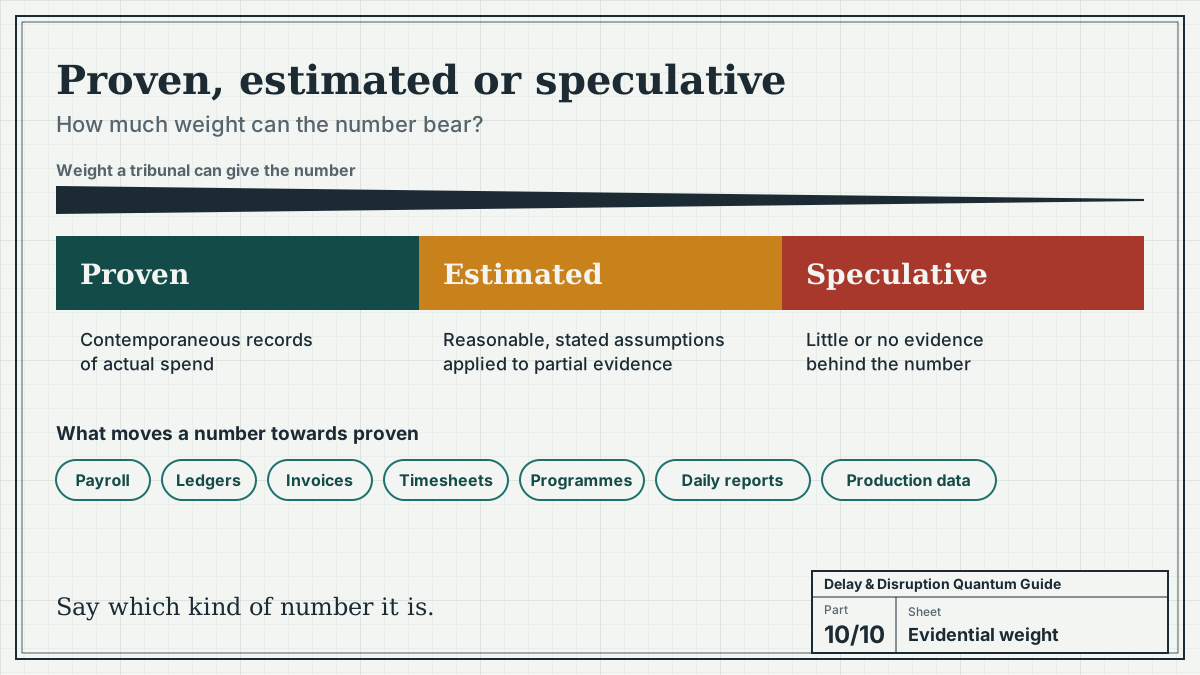
| Category | What supports it | Likely weight |
|---|---|---|
| Proven loss | Contemporaneous records of actual expenditure, resources and consequences | Highest |
| Estimated loss | Reasonable, stated assumptions applied to partial evidence | Reduced, and qualified |
| Speculative loss | Little or no evidence | Unlikely to be accepted |
Tribunals are far more likely to accept the first than the third. The expert's duty — reflected in the expert witness protocols and procedural rules commonly applied in GCC arbitration, such as the CIArb Protocol for the Use of Party-Appointed Expert Witnesses and the IBA Rules on the Taking of Evidence — includes identifying the facts and assumptions relied on, the evidence considered, any limitations in the available information, and any qualifications to the opinion.
Poor evidence versus better evidence
Weak:
"The project was delayed by eight weeks; our prolongation costs were therefore $5 million."
Stronger:
"The project was delayed by eight weeks. The camp remained open throughout. Payroll records show the project management team remained engaged. Vehicle hire, security and utilities continued. The additional cost incurred during the affected period was $X, as shown in the attached schedule and source documents."
The second is an actual-cost approach. It identifies the resources, the period, and the documents that prove the spend.
When records are incomplete
An expert generally cannot invent a value. But where records are partial, legitimate alternatives exist — each with progressively less certainty:
- Reasonable actual cost from what does exist — available invoices, payroll, ledger entries, contractor rates, known resource levels.
- Measured resource assessments — for example, 20 workers × 8 weeks × average labour cost, provided the workforce numbers are themselves evidenced.
- Industry or market-based valuation — sometimes appropriate where loss has not yet crystallised (rectification not yet carried out, replacement not yet purchased), but generally weaker than actual-cost evidence.
Applying the discipline to each head of claim
Prolongation. The question is what additional time-related cost was incurred because the project ran longer. Without payroll, cost reports, ledgers, invoices or resource records, proof becomes difficult. Some costs may be estimated, but the opinion will be qualified.
Disruption. Usually harder still. If the allegation is that workers lost productivity travelling daily from a distant town, the expert would want timesheets, rosters, bus schedules, travel records, labour reports and productivity records. Without them, it may be possible to calculate additional travel hours × labour rate, but not to prove a broader loss of productivity on the works.
Delayed operations or production. Here, accounting cost is not the only measure. The loss may be assessed as delayed revenue, delayed cash flow, lost contribution, lost profit or deferred production — figures that are modelled rather than invoiced. They still need evidence: mine or production plans, forecasts, budgets, board papers, operational schedules and actual production data. Without those, the valuation becomes highly speculative.
How the expert should say it
Two forms of words are particularly useful:
"I am unable to quantify this alleged loss on an actual-cost basis because the necessary contemporaneous records have not been produced."
"In the absence of actual records, I have adopted the following assumptions solely to illustrate a potential range of quantum."
And a suitable overall conclusion where records are thin:
"The absence of contemporaneous cost records does not necessarily prevent quantification. It will, however, materially affect the methodology available and the weight that may be given to any resulting opinion. Where actual cost evidence is unavailable, assessment may need to rely on reasonable assumptions, resource-based models or other indirect methods, and any such assessment is subject to greater uncertainty than one based on contemporaneous records."
The core document request
For a substantial delay and disruption claim, a quantum expert will typically need:
- baseline and updated programmes, commissioning schedules and operational readiness plans;
- daily and monthly progress records and manpower reports;
- payroll records and timesheets;
- contractor and subcontractor reports;
- accommodation, transport and logistics records;
- invoices and supporting documents;
- project cost reports and general ledger extracts;
- management accounts;
- production plans, forecasts and actual production and processing records (for owner claims); and
- correspondence relevant to causation and criticality.
Until these are reviewed, a responsible expert will not express a concluded view on recoverability, causation or quantum. The opinion must ultimately rest on demonstrable cause and effect, contemporaneous records, and actual costs and losses incurred.
Record-keeping: the lesson for the next project
The single most effective way to protect a future delay claim is to set up cost recording at project start so that it captures not only that cost was incurred but why. Modern project accounting systems can do this. Contractors that can separate delay-related site, head office and support costs from their own inefficiencies are in a far stronger position than those that cannot — and contractors that cannot may find recovery almost impossible.
Series conclusion
Across these ten parts, a single theme recurs: tribunals reward transparency and penalise assertion. Separate delay from disruption. Settle entitlement before quantum. Map every head of claim. Price the right resources, in the right period, on the right basis. Confront concurrency. Avoid global claims. And above all, be explicit about how much weight each number can bear.
Previous: Part 9 — Concurrency, Global Claims and the Causal Link. Back to: Series index
General information only, not legal advice.