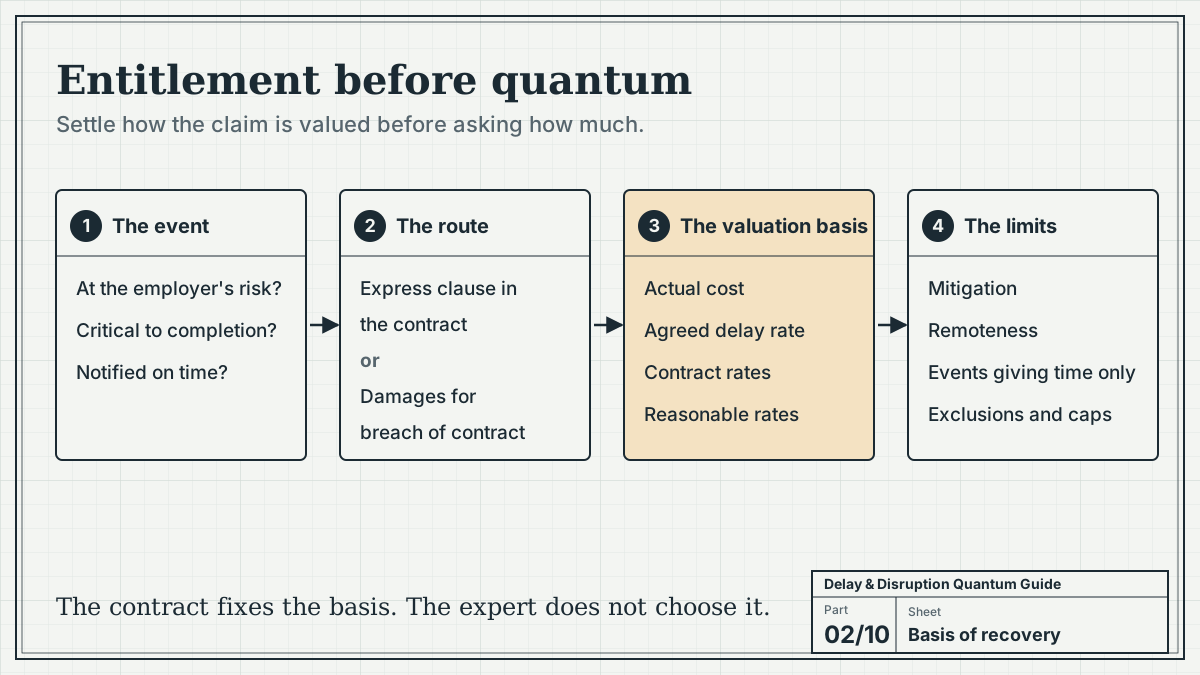
Part 2 of 10 — Delay & Disruption Quantum Guide
A quantum expert's first question is not "how much?" It is "on what basis?" The same eight weeks of delay can produce very different answers depending on whether the contract calls for actual cost, agreed rates, reasonable rates, or damages at law.
The typical shape of a delay cost claim
In most cases it is the contractor (or subcontractor) that claims delay costs, and the claim rests on two propositions:
- the work took longer than it would have done but for an event at the employer's risk; and
- because of that, the contractor incurred costs it would not otherwise have incurred.
Both limbs must be proved. The first is the province of the delay expert; the second belongs to the quantum expert. They must speak to each other.
Under the contract, or for breach?
A claim may be advanced:
- under the contract, through an express entitlement (for example, a loss and expense clause, or a Sub-Clause giving Cost for a specified event); or
- as damages for breach, where the contract provides no machinery for recovery.
Most modern standard forms provide express machinery, but clear words are generally needed to exclude a parallel claim in damages, and contractual rights usually sit alongside common law remedies rather than replacing them.
Where damages apply in a common law system, the aim is compensatory: to put the innocent party, so far as money can, in the position it would have been in had the contract been performed — but not in a better position. Recovery is limited by remoteness (Hadley v Baxendale; Victoria Laundry v Newman).
GCC note. Where UAE law governs, compensation principles derive from the Civil Code rather than English common law, and the treatment of actual loss, lost gain and foreseeability should be confirmed with UAE counsel before any report relies on them. [Verification flag — legal review required]
What is the valuation basis?
Even within a contractual claim, the valuation basis varies:
| Basis | What it means | Typical evidence |
|---|---|---|
| Actual cost / loss and expense | Reasonable cost actually incurred because of the delay | Ledgers, invoices, payroll, bank records |
| Agreed delay rate | A daily or weekly rate fixed in the contract or later agreed | The rate and the period |
| Contract rates | Bill or schedule rates applied, where reasonable | Priced bill, schedules, contract structure |
| Reasonable rates | A fair market rate where no contract rate fits | Market data, expert evidence |
Under FIDIC (2017 editions), "Cost" is defined broadly as expenditure reasonably incurred (or to be incurred), on or off Site, including overheads and similar charges but excluding profit; certain events instead attract "Cost Plus Profit". The particular Sub-Clause relied upon determines which applies. [Verification flag — confirm clause references against the edition in use]
The key lesson, explored further in Part 6, is that the contract — or a later agreement between the parties — fixes the basis. The expert does not choose it.
The duty to mitigate
A party suffering delay loss is expected to take reasonable steps (but no more than reasonable steps) to limit it. Loss that could reasonably have been avoided is not recoverable, while reasonable costs of mitigating are generally recoverable (British Westinghouse v Underground Electric Railways [1912] AC 673).
The burden of proving a failure to mitigate is usually on the paying party, but a prudent claimant will show what it did: demobilising idle plant, redeploying staff to other projects, renegotiating hire rates. In remote project settings — a mine camp, an offshore spread, a desert solar site — the reasonableness of keeping resources standing versus demobilising and remobilising is often a central battleground.
Critical and non-critical delay
Most standard forms link both extensions of time and time-related cost to delay to completion. That creates two traps:
- Excusable but not compensable events. Some risks (force majeure being the classic example) may give time but not money.
- Non-critical delay. A non-critical activity can be delayed without moving completion, so there is no extension of time — but the resources attached to that activity may still have been held for longer at real cost. Many contracts do not expressly compensate this, leaving a claim in damages. Occasionally it can be recovered under the contract — for example, where the employer's instructions that held up non-critical work can themselves be valued as a variation.
The burden: balance of probabilities
Whatever the basis, the claimant must prove its additional cost or loss on the balance of probabilities. It is entitled to be compensated for what it lost — and no more.
Practical takeaways for counsel
- Settle the legal basis and valuation basis before the quantum expert starts calculating.
- Check the specific clause: Cost, Cost Plus Profit, rates, or damages.
- Identify events that give time without money.
- Gather evidence of mitigation early; it is far harder to reconstruct later.
- Consider whether any non-critical delay cost is claimed and how it will be framed.
Previous: Part 1 — Delay Is Not Disruption. Next: Part 3 — Mapping the Heads of Claim.
General information only, not legal advice.