Part 5 of 10 — Delay & Disruption Quantum Guide
Delayed preliminaries — the cost of keeping the site running for longer — is usually the largest component of a contractor's delay claim. Where the entitlement is to loss and expense, Cost, or damages, the claim must be built on reasonable costs actually incurred.
What counts as preliminaries?
Preliminaries (also called site overheads, on-site overheads or indirect job costs) are costs that do not form part of the permanent works but are needed to deliver them. They divide into:
- Fixed items — one-off costs such as establishing site offices or demobilising at the end. These are incurred regardless of delay.
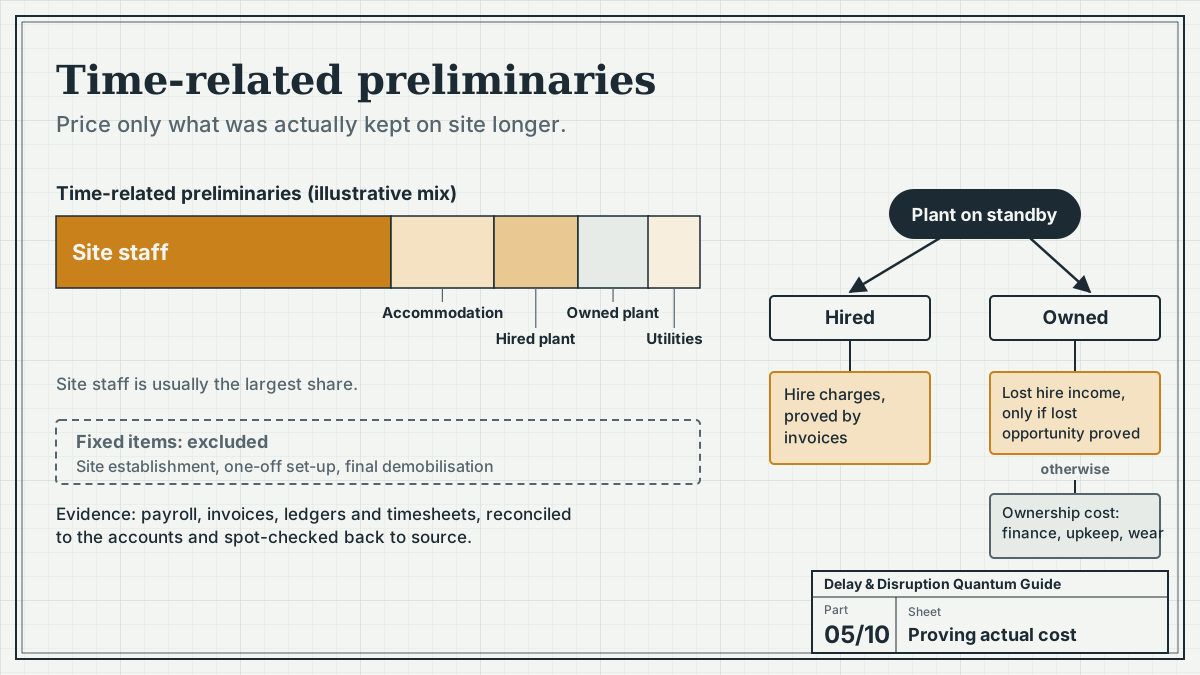
- Time-related items — site management and staff, accommodation running costs, temporary facilities, security, utilities, and plant used on the works. These continue to accrue while the project is extended.
Only the second category is generally recoverable as prolongation cost.
Preliminaries versus head office overheads
Preliminaries must be distinguished from head office overheads — the costs of running the business that are not tied to any particular project.
The boundary is not always clean. Some head office functions (a contracts manager, a planner, a commercial lead) may be charged directly to specific projects. Some site-based staff may work across several projects. Misclassification matters: if a contract allows an overhead percentage on top of prolonged preliminaries, moving costs from one category to the other changes the number.
A useful test: would the cost have been incurred to operate the business anyway, irrespective of this project? If yes, it is head office overhead. If it was incurred because of this project, it is a project cost.
Evidencing actual cost
Where the claim is cost-based, evidence comes from the contractor's accounting system and supporting records:
- purchase orders and paid invoices;
- payroll data;
- journal vouchers and ledger extracts;
- bank statements;
- supplier final accounts.
The burden is on the claimant to show that the costs were reasonably incurred and that it made reasonable efforts to keep them down.
Site staff — usually the largest element
In practitioner experience, site staff commonly account for the majority of delayed preliminaries cost — often well over half. Two issues arise:
- Function. The expert must confirm what each person was doing and whether their role corresponds to the reason for delay. A façade package manager kept on during a delay to MEP commissioning is a different proposition from a project director.
- Confidentiality. Payroll data is sensitive. Parties sometimes agree that an independent accountant verifies the payroll figures without the underlying salary data being widely disclosed.
Where staff were only partly engaged during the delay, or split between projects, timesheets must be detailed enough to isolate the delay-related portion.
Plant and equipment — hired or owned?
Hired plant standing idle generates hire charges, which can be evidenced by invoices.
Owned plant is different. If the contractor genuinely hires out its plant as a business, it may claim lost hire income — but it must prove it would have hired the plant out had it been free (Alfred McAlpine Homes North Ltd v Property and Land Contractors Ltd (1995) 76 BLR 59). If it cannot, recovery falls back to the actual economic cost of ownership: interest on capital tied up, maintenance, and depreciation, to the extent actually incurred.
Claiming owned plant at third-party hire rates without proving lost hire opportunity is a common error.
How the evidence is tested
A useful illustration is Ascon Contracting Ltd v Alfred McAlpine Construction Isle of Man Ltd (1999). The subcontractor's quantum expert relied substantially on print-outs from the subcontractor's accounting system. The other side argued that he had not independently verified the figures.
The court accepted his approach. He had independently checked headline totals — overall job cost, labour, and plant and materials — and found them to reconcile with the accounting records within small margins. He had not verified every allocation to site staff and overheads, given the cost of doing so. In the absence of any suggestion of fraud, the court was prepared to infer that the system data was the same data the business used for its own management.
The court also observed that insisting on strict criminal-standard proof of every entry would be out of step with practice in substantial construction litigation, where both sides' experts work from disclosed documents.
The lesson for experts: a print-out alone is the minimum. Good practice is to test the accounting data by spot-checking a sample of entries back to source invoices, payroll and bank records, and to reconcile headline totals. That materially strengthens the weight of the evidence.
Presentation matters
The claim should be arranged so that whoever must review it — the engineer, the employer's quantity surveyor, a dispute board, an opposing expert or a tribunal — can follow it, audit it and test it efficiently. That means:
- a clear schedule of each resource claimed;
- its role, period on site, and cost source;
- cross-references to the underlying documents;
- a reconciliation to the ledger.
Practical takeaways for counsel
- Insist on a resource-by-resource schedule, not a single preliminaries total.
- Check for owned plant claimed at hire rates.
- Consider early whether an agreed independent payroll verification protocol is appropriate.
- Ask the expert what level of verification has been done beyond the accounting print-out.
Previous: Part 4 — Labour Costs Under Delay. Next: Part 6 — When the Contract Sets the Price.
General information only, not legal advice.