Part 3 of 10 — Delay & Disruption Quantum Guide
When a claim first lands on an expert's desk, the pleaded figure often covers one or two obvious items. A careful review of the pleadings and witness material usually reveals a much wider set of alleged losses. Mapping them early — before anyone forms a view on recoverability — is one of the most valuable things a quantum expert can do for instructing counsel.
The primary heads
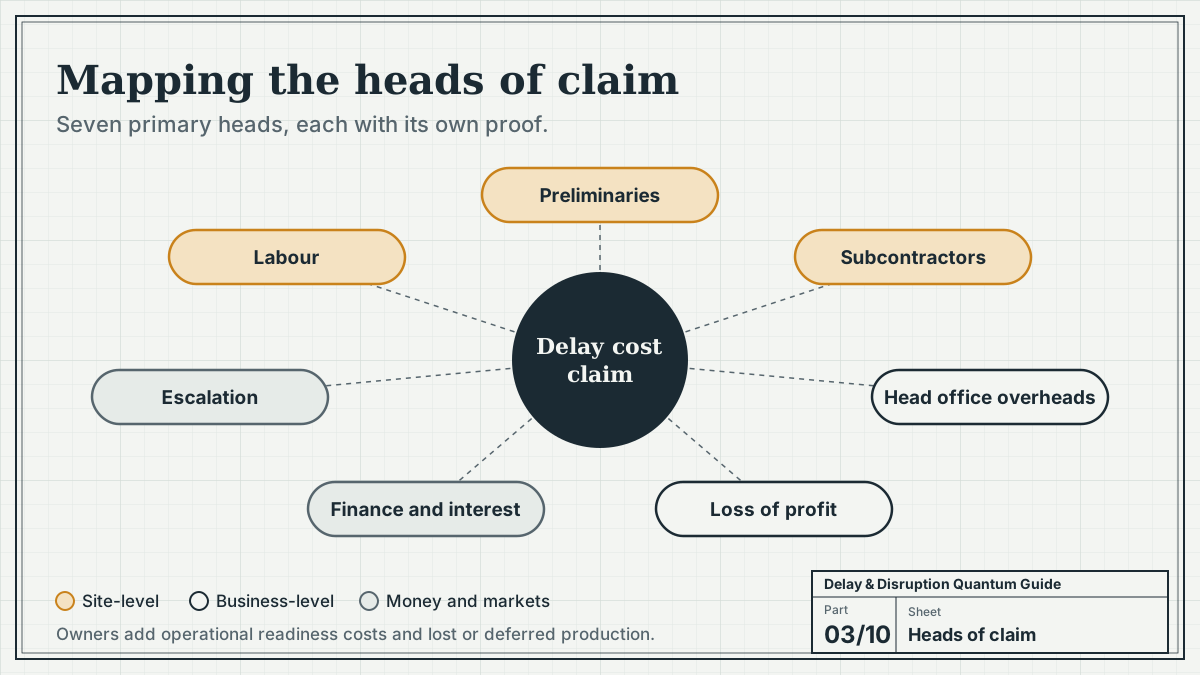
Delay cost claims are commonly organised under the following primary heads (the list is not exhaustive):
- Labour
- Preliminaries — on-site overheads or indirect job costs
- Subcontractor claims passed through
- Off-site or head office overheads
- Loss of profit
- Increased cost of resources (escalation)
- Finance charges and interest
Parts 4 to 8 of this series deal with each in turn.
A worked scoping example
Consider an anonymised example. An owner of a remote resources project engaged a supplier to deliver modular workforce accommodation. The buildings arrived late and with defects. The owner alleges that the shortfall in beds forced it to house workers in a town some distance away, delayed the build-out of the processing plant, and ultimately pushed back first production.
What began as a claim for "alternative accommodation costs" turns out, on review, to span the following categories. None of these is a conclusion on recoverability. Each requires investigation of entitlement, causation, criticality, mitigation and quantum.
Direct and transactional costs
- Payments made to the defaulting supplier, alleged overpayments, payments for incomplete work, credits and set-offs
- Value actually received for payments made
Substitute and workaround costs
- Alternative accommodation (hotels, caravan parks, other camps)
- Meals, catering, laundry and camp services
- Administration of temporary arrangements
Workforce logistics
- Contractor workforce accommodation, travel and messing
- Standby and extended workforce costs
- Additional supervision
- Bus transport, charter flights, vehicle costs
- Cancellation charges, freight, storage, mobilisation and remobilisation
Defect rectification
- Building, plumbing, waterproofing, joinery, electrical and air-conditioning rectification
- Furniture, fittings and equipment
- Inspection, supervision and completion costs
Ancillary operational costs
- For example, external laboratory testing and sample transport where an on-site facility was unavailable
Prolongation — site
- Camp operating and maintenance costs, utilities, communications, water, waste, security, cleaning, environmental monitoring, site administration
Prolongation — workforce
- Salaries and wages, statutory on-costs, labour hire
- Recruitment, medicals, inductions, retention
- Project, construction, engineering and contract administration personnel
Prolongation — contractors
- Extended management and supervision of principal contractors
- Mining, processing, drill-and-blast, civil and commissioning contractors
Prolongation — plant and equipment
- Equipment and vehicle hire, generators, temporary facilities, standing plant, preservation and extended hire
Head office support
- Commercial management, project controls, project accounting, IT, executive support, dedicated corporate resources
Disruption and productivity
- Paid travel time and non-productive labour
- Reduced productive hours, late shift starts and early finishes
- Reduced flexibility of workforce deployment
- Supervision inefficiency and coordination effort
- Restricted or partial mobilisation
- Trade stacking, congestion and out-of-sequence working
Operational readiness and delayed commencement
- Operations, maintenance and technical personnel recruited ahead of start-up
- Workshops, warehousing and operational fleets held idle
- Commissioning and start-up delay costs
Production and financial losses
- Deferred or lost production and revenue
- Lost contribution or operating margin
- Financing costs, facility fees, carrying costs and interest
Why the taxonomy matters
It separates time from productivity. The prolongation categories and the disruption categories must be kept apart (Part 1) to avoid double counting — for instance, travel time paid to workers bussed from a distant town is a disruption-type cost, but the same workers' base wages for an extended project are prolongation.
It exposes different valuation bases. Rectification costs, prolongation costs and lost production are valued in fundamentally different ways. The first is often invoiced cost; the second is time-related resource cost; the third is usually modelled from mine plans, forecasts and actual production data.
It drives the document request. Each category has its own evidential footprint (see Part 10). Scoping early lets counsel frame disclosure requests precisely.
It flags remoteness and contractual exclusions. Lost production and financing costs are frequently caught by consequential loss exclusions or limitation clauses. They should be identified so that the legal team can deal with entitlement before the expert spends time on valuation.
The same approach across sectors
The categories adapt readily:
- Rail and metro: possession costs, extended systems integration teams, rolling stock storage, delayed revenue service.
- Renewables and energy: extended EPC site establishment, module or turbine storage, grid connection slippage, deferred energy revenue or tariff payments.
- Building: extended preliminaries, trade stacking during fit-out, delayed handover affecting lease or sales income.
Practical takeaways for counsel
- Ask the expert for a preliminary heads-of-claim map, expressly marked as non-committal on recoverability.
- Use it to align legal analysis (entitlement, exclusions) with the quantum work plan.
- Treat production and financing losses as a separate workstream with its own evidence.
Previous: Part 2 — Entitlement Before Quantum. Next: Part 4 — Labour Costs Under Delay.
The example is anonymised and illustrative. General information only, not legal advice.