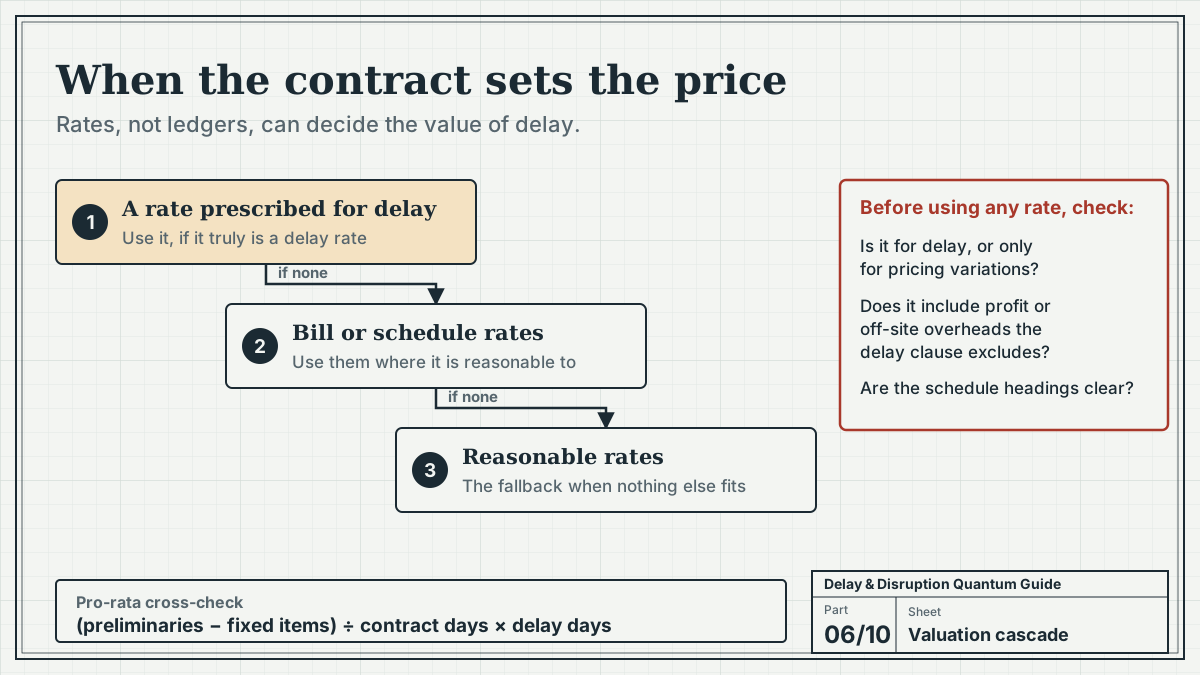
Part 6 of 10 — Delay & Disruption Quantum Guide
Not every delay claim is valued from the contractor's ledgers. The contract may fix a delay rate, direct the use of bill or schedule rates, or fall back to "reasonable rates". When it does, the quantum exercise changes — and ambiguous drafting can generate disputes worth millions.
The options
Where a contract provides for delayed resources to be valued on a basis other than cost, the valuation may use:
- an agreed, all-inclusive delay rate stipulated in the contract or agreed later;
- contract rates from a priced bill or schedule, to the extent reasonable; or
- reasonable rates where neither of the above applies.
Contract rates are usually the contractor's own estimates. They may be higher or lower than what was actually spent. Which basis applies is a matter of contract and any later agreement — not of the expert's preference.
The cleanest case: an agreed delay rate
If the parties have agreed a single all-inclusive daily or weekly delay rate, the quantum exercise is largely mechanical once the compensable period is settled: rate × period. The fight moves almost entirely to the delay analysis.
For employers and contractors negotiating contracts on GCC infrastructure and energy projects, an agreed delay rate (perhaps stepped by project phase) can significantly reduce the cost and uncertainty of later disputes.
Pro-rating tender preliminaries
A common alternative is to derive a daily rate from the priced preliminaries:
- take the total preliminaries price;
- remove fixed (non-time-related) items;
- divide by the contract duration;
- multiply by the compensable delay period.
In Ascon v McAlpine (1999), counsel for the paying party proposed exactly this as a cross-check, and the court used it as a reference point alongside the claimant's cost-based figure before settling on a rate of its own.
This method is appropriate where the parties have agreed it, or where the contract directs bill rates to be used and spending on preliminaries was broadly even across the project. It is much less appropriate where:
- the contract entitles the contractor to actual cost; or
- preliminaries expenditure fluctuated significantly (as it nearly always does — see Part 7).
If an average across the whole contract period is used, it will usually need adjustment to reflect the resources actually affected at the time of the delay.
When the contract is unclear: common drafting traps
Ambiguous rate provisions are a frequent source of dispute. A typical pattern looks like this.
The delay cost clause allows the contractor its extra direct costs and its on-site overheads attributable to the delay, but excludes off-site overheads and profit. On-site overheads are to be valued under a cascading valuation clause:
- specific rates prescribed by the contract, if any;
- otherwise, rates in a priced bill or schedule of rates, where reasonable;
- otherwise, reasonable rates.
The contractor then points to a line item in a daywork schedule — say, an "overall composite daily rate" covering staff and facilities — and multiplies it by the extension of time granted. That approach is vulnerable on several fronts:
- the schedule may sit within the rates for pricing variations, and a delay claim is not a variation;
- inconsistent schedule headings and structure make it unclear what the rate was meant for;
- daywork rates ordinarily include profit and off-site overheads, which the delay clause excludes, and unless the rate is shown to exclude them it cannot be used for a cost-only entitlement; and
- a tribunal may decline to use pre-contract negotiations to fill the gap.
If the rate fails, the cascade usually falls through to reasonable rates — and the quantum exercise starts again.
Two further points of method commonly arise in this situation:
- Match the period to the entitlement. If the clause compensates overheads attributable to the delay to completion, the analysis should look at the time-related overheads retained for the period of the extension, rather than trying to attach specific overheads to delays on individual activities.
- Use a weighted average. Where a daily rate is derived from several delay events of different durations and values, a weighted average — not a simple average of the daily figures — is the appropriate way to arrive at it.
Drafting lessons for GCC contracts
- If a delay rate is intended, say so expressly — identify it as the rate for valuing compensable delay, state what it includes and excludes (profit, off-site overheads), and place it in a clearly titled schedule.
- Do not rely on daywork schedules to do double duty as delay rates.
- Keep schedule headings consistent across every page.
- Where FIDIC is amended through Particular Conditions, check that the definitions of Cost and Cost Plus Profit interact sensibly with any agreed rate.
Practical takeaways for counsel
- Identify the valuation basis from the contract before instructing the expert.
- Where a rate is relied on, test whether it is truly prescribed for delay, and whether it includes items the delay clause excludes.
- If averaging is used, ask how the average was weighted and over what period.
Previous: Part 5 — Time-Related Preliminaries. Next: Part 7 — Which Period? Assessing Prolongation When the Effect Was Felt.
General information only, not legal advice.