Part 8 of 10 — Delay & Disruption Quantum Guide
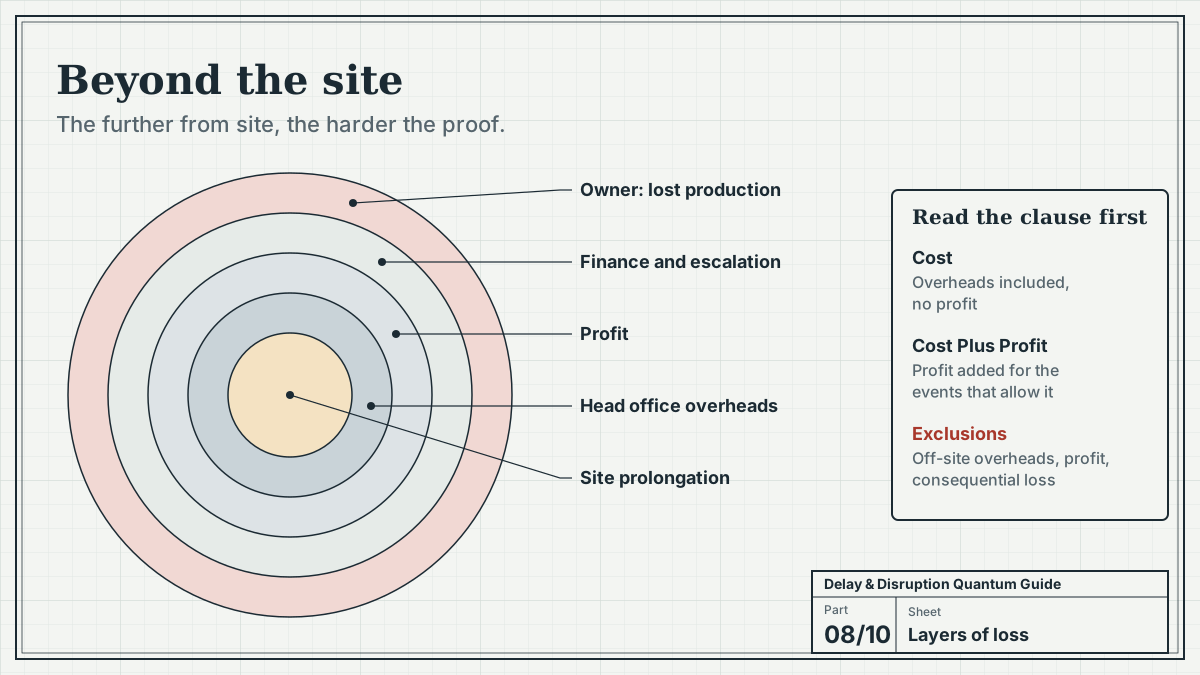
Site-level prolongation costs are the core of most delay claims. But the larger numbers — and the hardest arguments — often sit beyond the site boundary: head office overheads, lost profit, financing costs and, for owners, delayed revenue.
Head office overheads
What is claimed
Head office overheads cover the costs of running the business that are not specific to any project: general administration, premises, IT, marketing, plant yards and workshops, and so on. The argument is that, during the period of delay, the project carried a share of those costs for longer than planned — or that the business lost the chance to recover them from other work.
Two different propositions
It matters which proposition is being advanced:
- Extra overhead actually incurred because of the delay (for example, head office staff dedicated to the delayed project, or additional management time); or
- Unrecovered overhead / lost contribution, because the delayed project tied up capacity that would otherwise have earned contribution on other work.
A clause compensating "extra costs" incurred because of an extension will not necessarily extend to income the contractor lost because the delay prevented it from undertaking other work (Part 7). A distinction can properly be drawn between off-site overheads incurred generally and those actually caused by the extension. The wording of the entitlement clause is therefore decisive.
Contract exclusions
Some contracts exclude off-site overheads from delay compensation entirely (see the example in Part 6). Others allow a "reasonable amount for overheads", or define Cost to include overhead charges whether on or off site (as FIDIC's definition does). Check the clause before any calculation is done.
Percentage additions
Where both parties accept that overheads are recoverable, a percentage addition to prolonged site costs is a common, pragmatic approach. In Ascon v McAlpine the parties agreed this method and differed only on the rate; the court found both proposed rates within a reasonable bracket and adopted a figure close to the tender breakdown.
Formula approaches
Formula-based methods for unabsorbed overhead (commonly referred to as Hudson, Emden and Eichleay formulae) are frequently advanced and frequently contested. Their weakness is that they tend to assume, rather than prove, that the contractor lost the opportunity to earn overhead recovery elsewhere. A tribunal will usually expect evidence of that lost opportunity — for example, tenders declined for lack of capacity — and of the contractor's actual overhead and turnover.
Loss of profit
Whether profit is recoverable depends heavily on the mechanism:
- Some clauses give Cost only; others give Cost Plus Profit (FIDIC distinguishes these event by event).
- Delay clauses frequently exclude profit expressly.
- In a damages claim, lost profit on other work must be proved on the evidence, not assumed, and must not be too remote.
Profit should never be embedded silently in rates used for a cost-only entitlement. As the drafting traps in Part 6 show, rates that may include profit cannot be used to value a claim from which profit is excluded.
Increased costs of resources
Delay can push work into a period of higher prices: labour rates, materials, fuel, freight. Where the contract has a price adjustment (fluctuations) mechanism, that usually governs and must not be duplicated in the delay claim. Where it does not, escalation attributable to employer-risk delay may be claimed, but the claimant must show what it would have paid without the delay and what it actually paid.
Finance charges and interest
A contractor delayed by the employer may have more capital tied up for longer — retention held longer, plant and materials paid for but not certified, negative cash flow during periods of low progress (see Part 7). Finance charges can be a recoverable loss where the contract or governing law allows. They must be distinguished from statutory or contractual interest on late payment, which is a different entitlement. In the UAE, the availability and rate of interest is a matter for local law and must be confirmed by counsel. [Verification flag — legal review required]
Owner-side losses: delayed operations and lost production
For owners and developers — a mine, a power plant, a desalination facility, a toll road, a retail mall — the most significant loss from delay is often commercial: deferred revenue, lost production or lost contribution.
These losses are typically modelled, not invoiced. They need a robust evidential base:
- mine plans or production schedules;
- production forecasts, budgets and board papers prepared before the dispute;
- operational readiness plans and commissioning schedules;
- actual production and processing data once operations began; and
- market price data for the relevant period.
Owners also incur operational readiness holding costs: operations and maintenance teams recruited ahead of start-up, warehousing, workshops and operational fleets that sit idle while construction finishes. These are closer to actual cost and usually easier to prove than lost revenue.
Two cautions:
- Deferred is not lost. If production was simply shifted later (the orebody is still there; the plant still generates for its full design life), the true loss may be the time value of money, not the full revenue for the delay period.
- Exclusions. Lost profit, revenue and production are frequently excluded as consequential loss or capped by limitation provisions. Entitlement must be resolved before valuation.
Practical takeaways for counsel
- Read the entitlement clause for overheads and profit before instructing the expert.
- Distinguish extra overhead incurred from lost contribution; they need different proof.
- Treat formula-based overhead claims with caution unless lost opportunity can be evidenced.
- For owner claims, separate operational holding costs (cost-based) from lost or deferred revenue (model-based), and test whether production was lost or merely deferred.
Previous: Part 7 — Which Period? Next: Part 9 — Concurrency, Global Claims and the Causal Link.
General information only, not legal advice.