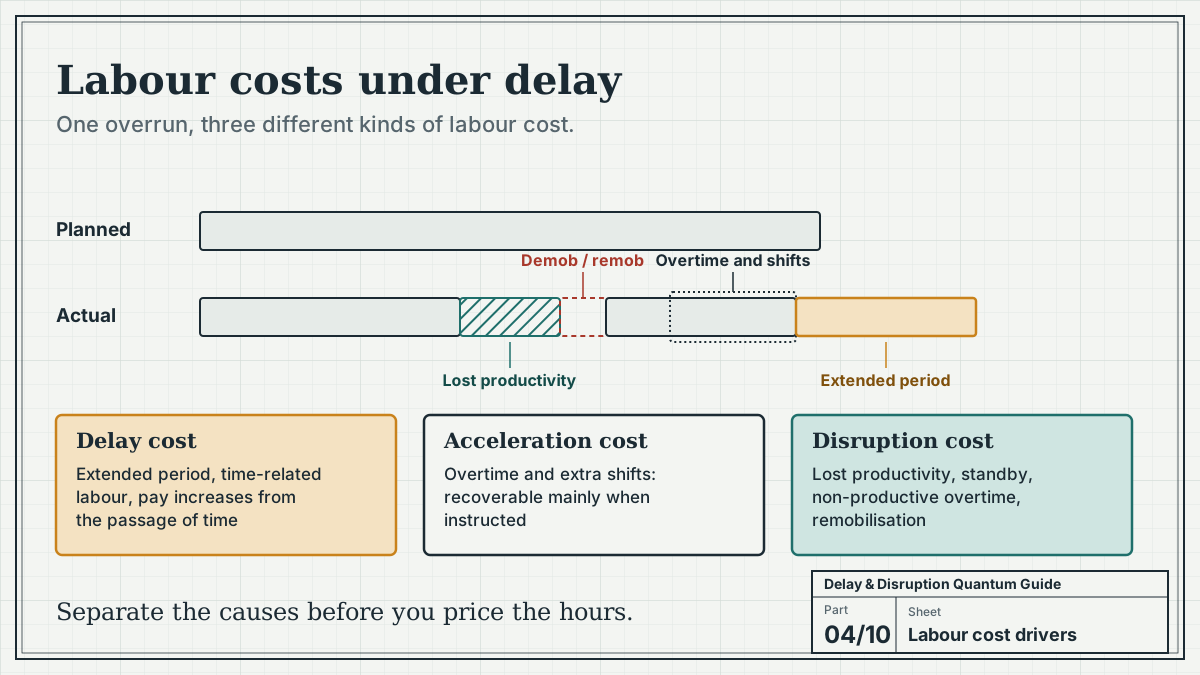
Part 4 of 10 — Delay & Disruption Quantum Guide
Labour is often the hardest head of claim to pin down. It is difficult to monitor in normal conditions; once delay, acceleration and disruption are happening at the same time, separating their effects becomes a forensic exercise.
Direct and indirect labour
Contractors usually divide their workforce into:
- Direct labour — the operatives physically building the works; and
- Indirect labour — supervisors, foremen, cleaners, traffic marshals, storemen and others who support the work but do not produce it.
Classification varies between contractors, so the expert must understand how this contractor categorised its people before comparing anything.
How delay drives labour cost
Delay can increase labour cost in several ways:
- working for an extended period;
- overtime and additional shifts;
- pay increases triggered by the passage of time;
- loss of productivity;
- non-productive overtime;
- non-productive (time-related) labour; and
- demobilisation and remobilisation.
Some of these flow directly from critical delay. Others are by-products of the measures taken to deal with it. The cause of each must be identified.
Extended periods, overtime and shifts
If the workforce has to stay longer because of employer-risk delay, there will almost certainly be extra cost. Often, though, the contractor responds by working overtime or extra shifts — either on instruction or of its own accord — to recover time.
That creates a mixed cost picture: part prolongation, part acceleration, and possibly part disruption. Each has a different entitlement basis. A tribunal will expect the expert to show which costs belong where, and contractors rarely record them that way.
Instructed or voluntary? Acceleration costs are far easier to recover where the employer instructed the acceleration (or where a constructive acceleration argument can be made out). Voluntary acceleration to avoid delay damages may not be recoverable at all.
The subcontracted workforce
On most large GCC projects, the main contractor's own labour force is modest; the bulk of the work is subcontracted. That shifts the problem:
- the loss is primarily the subcontractor's; and
- to recover what it paid a subcontractor, the main contractor must show the payment was reasonable and compensated a genuine loss.
The subcontractor must prove its own claim. A main contractor that settles a subcontractor's delay claim generously, without adequate support, may find it cannot pass the cost upstream.
Pay increases
Delay can push work into a period where higher wage rates apply — a new collective agreement, an annual increment, or a statutory change. Whether that increase is recoverable depends on the contract wording.
English authority shows how narrowly this can be read. In William Sindall Ltd v North West Thames RHA (1977), increases flowing from a voluntary bonus scheme were not recoverable under a fluctuations mechanism tied to a national joint council, although increases mandated by that council would have been. In JC & Sons Ltd v Southwark LBC (1981), increases paid to self-employed labour fell outside a clause covering defined "workpeople".
Where the contract allows recovery of all reasonable demonstrable costs, the position is likely to be more generous. Either way, it turns on the wording.
Loss of productivity
Delay often triggers disruption: piecemeal access, out-of-sequence work, crowding, trade stacking, diluted supervision across fragmented gangs, fatigue from sustained overtime, and declining morale. Idle time and standby follow. These are dealt with as disruption (Part 1) and must not be double counted with prolongation.
Non-productive overtime and labour mix
Extended overtime tends to produce diminishing returns as fatigue sets in. Contractors under pressure also change their labour mix — substituting semi-skilled for skilled operatives, or vice versa. That can increase hours without increasing cost, or increase cost without increasing hours.
Any productivity analysis — a measured mile or similar comparison — must account for labour mix, or it will compare unlike with unlike. A contractor's "overall increase in labour cost" figure, unconnected to specific events, invites all the problems of a global claim (Part 9) and should be avoided.
Non-productive, time-related labour
Cleaners, labourers supporting general site operations, traffic management and similar roles are largely time-related. Their cost tends to track critical delay closely and is usually the easiest labour element to evidence.
Demobilisation and remobilisation
When work in one area cannot proceed, crews may be moved to another area and then moved back once access is available. On large or linear sites — a rail corridor, a pipeline, a utility-scale solar field — repeated moves can be very costly. The expert needs records showing when crews moved, why, and what it cost.
Practical takeaways for counsel
- Establish early whether overtime and extra shifts were instructed or voluntary.
- Identify which labour is directly employed and which is subcontracted; the evidential burden differs.
- Check the contract wording on wage escalation before pursuing pay-increase claims.
- Require the expert to show labour mix has been accounted for in any productivity comparison.
Previous: Part 3 — Mapping the Heads of Claim. Next: Part 5 — Time-Related Preliminaries: Proving Actual Cost.
General information only, not legal advice.