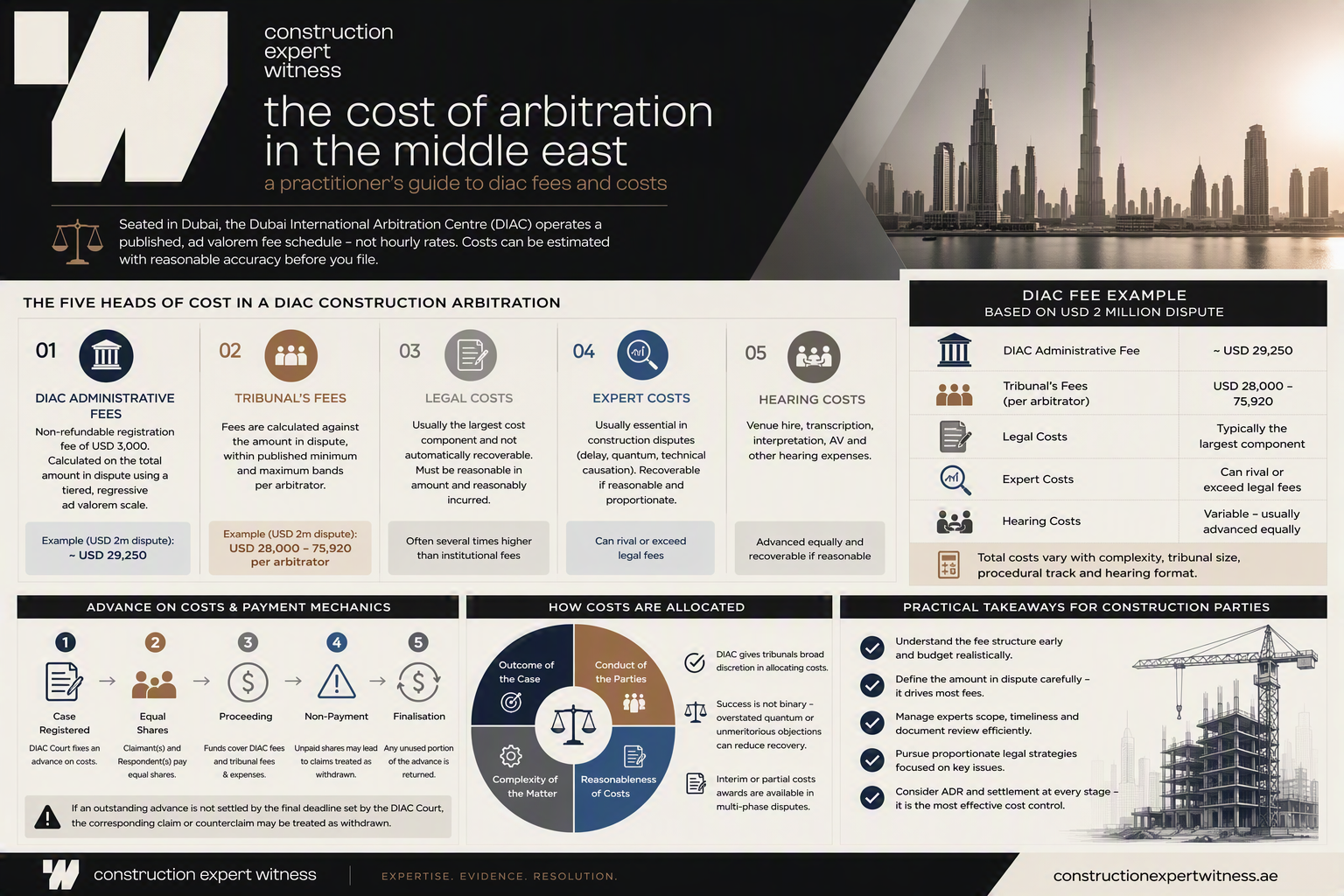
For any party facing a construction, infrastructure or energy dispute in the UAE, the decision to commence arbitration is rarely taken lightly, and cost is almost always the first practical question raised in-house. Seated at the Dubai International Arbitration Centre (DIAC), the region's leading arbitral institution for construction and engineering disputes, the answer is more structured than many parties expect. DIAC operates a published, ad valorem fee schedule rather than the hourly-rate models common to court litigation, which means costs can be estimated with reasonable accuracy before a Request for Arbitration is ever filed.
This matters most in construction disputes, where the amounts in dispute are large, the evidentiary record is voluminous, and expert evidence on delay, disruption, quantum and technical causation is central rather than incidental. Understanding how DIAC's cost structure interacts with those features is essential to realistic budgeting and to strategic decisions on quantum, procedure and settlement.
The legal framework: 2022 DIAC Arbitration Rules and the 2025 Table of Fees and Costs
Costs in DIAC arbitrations are governed by two instruments read together: the 2022 DIAC Arbitration Rules, which set out the general principles of cost allocation and the advance-on-costs mechanism, and the DIAC Table of Fees and Costs, which fixes the amounts payable. DIAC revised the Table of Fees and Costs with effect from 1 January 2025 — the first revision in over thirteen years — introducing new general provisions on payment practices, a more detailed ad valorem structure for administrative and tribunal fees, and provision for VAT and similar taxes where relevant. The revised table applies to cases registered on or after that date, so confirm which version governs a matter before advising on likely costs, particularly for disputes straddling the transition.
The five heads of cost in a DIAC construction arbitration
A DIAC arbitration typically involves five distinct heads of cost, each with a different payer, timing and recoverability profile.
DIAC's administrative fees
DIAC charges a non-refundable registration fee of USD 3,000 for a claimant commencing arbitration, and the same fee applies to a respondent introducing a counterclaim. Beyond registration, the administrative fee is calculated on the total amount in dispute — the aggregate value of all claims, counterclaims and set-offs — using a tiered, regressive ad valorem scale combining fixed and percentage-based components. As an illustration, a dispute valued at USD 2 million would attract an administrative fee in the order of USD 29,250. Where the amount in dispute cannot be ascertained, or exceeds USD 100,000,001, the DIAC Arbitration Court determines the applicable fee by reference to the circumstances of the case rather than the standard table.
The tribunal's fees
Arbitrator fees are likewise calculated against the amount in dispute, within published minimum and maximum bands per arbitrator. For a USD 2 million dispute, each arbitrator's fee — whether sitting alone or as part of a three-member tribunal — would generally fall between roughly USD 28,000 and USD 75,920, a range reflecting the Arbitration Court's discretion to account for complexity, diligence and the time actually required. In construction matters involving multiple concurrent delay events, competing programming methodologies or extensive as-built analysis, tribunals are more likely to be remunerated toward the upper end of the band, and reasonable tribunal expenses (travel, accommodation and an approved tribunal secretary) are added on top.
Legal costs
Legal fees are, in almost every construction arbitration, the largest single cost component, frequently exceeding the combined institutional and tribunal fees several times over. Recoverability is not automatic: the tribunal has broad discretion, and a successful party must generally satisfy the tribunal that the fees claimed were reasonable in amount and reasonably incurred, having regard to the complexity of the case and the parties' conduct during the proceedings.
Expert costs
In construction, infrastructure and energy disputes, expert evidence is rarely optional. Delay and disruption analysis, quantum assessment and technical or structural causation typically require independent experts working within frameworks such as the SCL Delay and Disruption Protocol, the IBA Rules on the Taking of Evidence and the CIArb Protocol for Party-Appointed Expert Witnesses. These costs are advanced by the appointing party but are, in principle, recoverable from the losing party provided they are reasonable and proportionate to the issues in dispute. Because a well-substantiated delay or quantum report often requires review of thousands of programme revisions, site records and items of correspondence, expert fees in complex references can rival — and occasionally exceed — legal fees, a factor tribunals increasingly scrutinise at the costs stage.
Hearing costs
These cover venue hire, transcription, interpretation and audiovisual arrangements for the final hearing, and vary considerably depending on whether the hearing proceeds virtually, physically or in hybrid format. Hearing costs are usually advanced in equal shares and are, like the other heads above, generally recoverable by the successful party subject to reasonableness.
The advance on costs and payment mechanics
Once a case is registered, the DIAC Court fixes an advance on costs covering DIAC's own fees and the tribunal's fees and expenses, calculated by reference to the total sums claimed and counterclaimed. The advance is payable in equal shares by the claimant(s) and respondent(s), regardless of how liability is ultimately allocated. If a party fails to pay its share, the other party is typically invited to cover the shortfall so the arbitration can proceed, and unpaid shares may themselves become the subject of a costs award. Critically, if an outstanding advance is not settled within a final deadline set by the DIAC Court, the corresponding claim or counterclaim may be treated as withdrawn — a consequence respondents pursuing substantial counterclaims should factor into strategy. Any unused portion of the advance is returned once the arbitration concludes.
How costs are allocated
Unlike institutions applying a strict costs-follow-the-event default, DIAC's regime gives the tribunal considerable discretion in allocating costs, having regard to the outcome and the parties' conduct. That flexibility cuts both ways in construction disputes: a claimant who succeeds on liability but significantly overstates quantum, or a respondent who raises unmeritorious procedural objections, may see cost recovery reduced even where it otherwise prevails. Interim or partial costs awards are also available, which can be a useful lever in multi-phase references bifurcated between liability and quantum.
Practical cost considerations for construction parties
Because administrative and tribunal fees are tied directly to the amount in dispute, accurate early quantification materially affects the advance on costs and should not be left to late-stage case preparation. Practical steps include:
- Quantify realistically at the outset, including contingent claims, extension of time entitlements and prolongation costs.
- Obtain delay or quantum expert input before pleadings close to narrow the issues genuinely in dispute and test settlement prospects.
- Agree a tailored procedural timetable with defined expert conferencing (hot-tubbing) where the volume of programme, cost or technical evidence is large.
- Consider virtual or hybrid hearings where the complexity of the evidence allows, reducing venue, travel and accommodation costs.
- Avoid procedural steps that add cost without corresponding evidentiary value.
Why this matters for expert-led construction disputes
For parties and counsel preparing a DIAC-seated construction reference, cost planning and evidentiary strategy are inseparable. A delay analysis prepared to a defensible methodology, a quantum report built on a transparent and auditable basis, and structural or technical evidence scoped proportionately to what is genuinely in dispute serve two purposes at once: they strengthen the substantive case, and they support the reasonableness of the costs ultimately claimed. Given the discretion DIAC tribunals retain over allocation, the credibility and proportionality of expert evidence is a cost recovery issue in its own right.
Our quantum, delay and technical expert witnesses are regularly appointed in DIAC-seated construction arbitrations across the UAE and wider GCC, and advise on the scope and sequencing of expert evidence so that it remains proportionate to the amounts in dispute.
This article is provided for general information and reflects the DIAC Table of Fees and Costs in effect from 1 January 2025 and the 2022 DIAC Arbitration Rules. It is not legal advice. Parties should obtain tailored advice from qualified UAE counsel and confirm current DIAC fee tables before budgeting for a specific matter.